Sunday, 28 August 2011


Answers to Entrance Activity for 4.7
Answers to
Entrance Activity for 4.7
Answers...
1. What is the most common heat transfer mechanism in solids? Conduction
2. What is the most common heat transfer mechanism in liquids and gases? Convection
3. What is the only heat transfer mechanism in a vacuum? (Infra-red) Radiation
4. Why can't conduction happen in a vacuum? There are no particles in a vacuum to transfer the vibrations
5. What happens to the space between the particles in a gas when you heat it? The space between the particles increases
6. What happens to the density of a gas when you heat it? It decreases because the space between the particles increases
7. Why can't convection happen in a solid? In a solid the particles are fixed in position and are not free to move
Entrance Activity for 4.7
Answers...
1. What is the most common heat transfer mechanism in solids? Conduction
2. What is the most common heat transfer mechanism in liquids and gases? Convection
3. What is the only heat transfer mechanism in a vacuum? (Infra-red) Radiation
4. Why can't conduction happen in a vacuum? There are no particles in a vacuum to transfer the vibrations
5. What happens to the space between the particles in a gas when you heat it? The space between the particles increases
6. What happens to the density of a gas when you heat it? It decreases because the space between the particles increases
7. Why can't convection happen in a solid? In a solid the particles are fixed in position and are not free to move
Friday, 19 August 2011
4.6
4.6 recall that energy transfer may take place by conduction, convection and radiation Task 1 Try the animation: particle model - conduction
Extension: what is the limitation of this animation? (Check your answer with the Heating a Solid animation)
The animation does not show that in addition to the vibration of the particles, the block of metal is supposed to expand.
Task 2
Try the quiz on the Cooking animation
Extension: what's the mistake in the description of convection?
The mistake is that the particles aren't supposed to shrink and sink just because they were cooled down. 
Extension: what is the limitation of this animation? (Check your answer with the Heating a Solid animation)
The animation does not show that in addition to the vibration of the particles, the block of metal is supposed to expand.
Task 2
Try the quiz on the Cooking animation
Extension: what's the mistake in the description of convection?
The mistake is that the particles aren't supposed to shrink and sink just because they were cooled down.
Sunday, 19 June 2011
4.5
________________________________________
From: Matt Baker
Sent: Monday, June 20, 2011 8:13 AM
To: Antti Markkanen; Aufar Alif Waldi; Charlotte Cowley; Eliza Mae De Vries; Harriet Beattie; Huei-Yu Daniel Lo; James Arias; Jesper Kwant; Kirk Leekasem; Nicholas Chu; Nuntikorn Kuvanant; Pankhuri Singh; Rajdamrong Diskul; Robins McIntosh; Samir Apaya; Sanhacha Chitvaranund; Savannah Eve Gough; Siraket Wongchindawest; Tatiksha Singh; Yanida Areekul
Cc: maddogscience@posterous.com
Subject: 4.5 4.5 describe a variety of everyday and scientific devices and situations, explaining the fate of the input energy in terms of the above relationship (see 4.4), including their representation by Sankey diagrams
1) 2) wasted heat= 400J Efficiency= useful energy out/total energy in Heat to water= 1000J 1000/2000= 0.5
Sound energy= 600J
3) 4)
efficiency= useful energy out/total energy in 150-30=120J 120/150= 0.8 
From: Matt Baker
Sent: Monday, June 20, 2011 8:13 AM
To: Antti Markkanen; Aufar Alif Waldi; Charlotte Cowley; Eliza Mae De Vries; Harriet Beattie; Huei-Yu Daniel Lo; James Arias; Jesper Kwant; Kirk Leekasem; Nicholas Chu; Nuntikorn Kuvanant; Pankhuri Singh; Rajdamrong Diskul; Robins McIntosh; Samir Apaya; Sanhacha Chitvaranund; Savannah Eve Gough; Siraket Wongchindawest; Tatiksha Singh; Yanida Areekul
Cc: maddogscience@posterous.com
Subject: 4.5 4.5 describe a variety of everyday and scientific devices and situations, explaining the fate of the input energy in terms of the above relationship (see 4.4), including their representation by Sankey diagrams
1) 2) wasted heat= 400J Efficiency= useful energy out/total energy in Heat to water= 1000J 1000/2000= 0.5
Sound energy= 600J
3) 4)
efficiency= useful energy out/total energy in 150-30=120J 120/150= 0.8


Sunday, 12 June 2011

Friday, 10 June 2011
SCIENTIFIC FACTS TO REMEMBER NEXT TIME.
-Unbalanced forces means that the object is accelerating not "going forwards"
-remember a=(v-u)/t
-acceleration's units are m/s2
-To independently turn off lamps in a series circuit, make it parallel and add its own switch.
-The cell of a circuit affects its current.
- The law of reflection is: (angle) i = (angle) r
- Diffraction for small gap= lines curve into a semicircle.
Diffraction for big gap= lines only curve on the ends.
Sunday, 22 May 2011
3.17 Investigating the refraction of light
-We found out that light slows down as it tries to go through dense material.
-because it slows down it bends since one side goes slower than the other
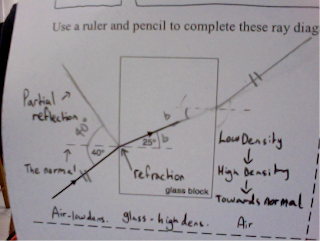 - also, some partial reflection is shown
-because it slows down it bends since one side goes slower than the other

Subscribe to:
Posts (Atom)